
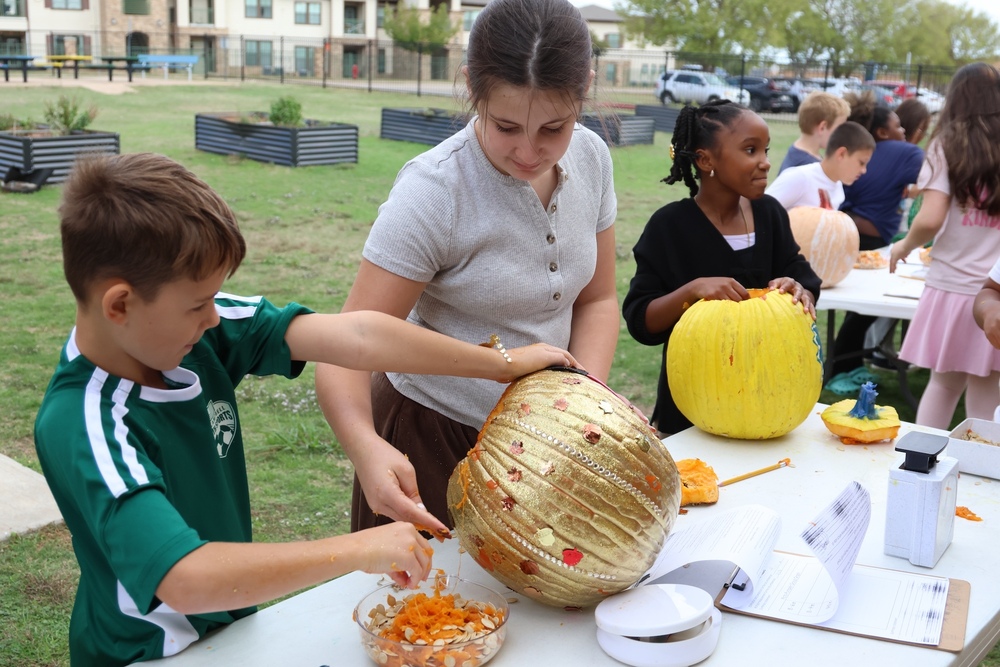
The old saying “One man’s trash is another man’s treasure” proved to be true at Carriage Hills Elementary School when fifth graders recycled decorated pumpkins for lessons in math, science and language arts.
After the school’s annual pumpkin decorating contest, fifth grade teacher Michelle Blackwell rescued the pumpkins from the refuse heap so her students could conduct a series of experiments with them, including measuring the circumference, weighing them, dunking them in a bucket of water to see if they float, and counting the seeds once they pulled the insides out. Students then had several writing assignments, including persuasive writing where they must convince someone not to carve up a pumpkin.
“I don’t like to waste things. Every year the teachers donate their pumpkins,” Blackwell said.
The dozen or so pumpkins were set out on tables outside the fifth grade classrooms and students were divided into random teams as they began their experiments and recorded the results.
First, students used a piece of string to measure the circumference. Students were instructed to wrap the string around the fat part of the pumpkin, then stretch the string out on a yardstick to arrive at the circumference. Students then used the yardstick to measure the height, including the stem, and then hefted their pumpkin onto a scale to weigh it.
“This pumpkin is too fat. It needs exercise,” said Tristan Isenhower as he tried to lift his pumpkin onto a small scale.
Measurements completed, it was time to dunk the pumpkin into a bucket of water to see if it would float or sink.
“I say it will sink. It will be too heavy,” said Kamryn Buckmaster.
“It will sink because it’s just too heavy,” Amaya Barber concurred.
“If you got rid of all the extra fat. it would float if it was a skinny pumpkin,” Buckmaster said.
Much to the surprise of most of the students, pumpkins float despite their size and heft.
The vital signs out of the way, it was time to really plunge into the meat of the activity — taking the “guts” out and removing the seeds.
Students had different reactions to plunging their hands into the inside of a pumpkin and pulling out an orange handful of pulp and seeds.
“It feels like slime, like wet bread that’s sticky,” said Paisley McCoy. “They didn’t warn us about how slimy it is.”
“I think it will feel like what I imagine a brain would feel like — slimy and gross,” said Kaizer Morales.
Once the pumpkins had been gutted and deseeded, students weighed the pumpkins again to see if there was a change in the weight, and then weighed the guts and seeds.
On the second day of the activity, students were given the bag of seeds they had harvested and were asked to count them.
“I’ve got lots of seeds,” said Phoenix Garman, whose partner was absent. “I’ve got to count the seeds by myself. I probably have like 200. They are soaking wet,” he said as he grouped his seeds by 10s into piles.
How long did he think it would take to count all those seeds by himself?
“Two hundred years,” Garman said as he eyed his pile. At one point, he had counted 260 seeds and still had a pile to count, causing him to revise his estimate of the number of seeds to 1,000.
The team of Nikolai Fred and Avalyn Stevens also had to revise their estimate of the number of seeds. One guessed 156 seeds and the other guessed 200.
“This is 160, so I think my estimate was definitely wrong,” Stevens said as she counted one pile and reached for more.
Willow Greeley was one of the first to finish counting. She grouped her seeds into piles of 10, then arranged them in rows on the table. She, too, missed her estimate. She counted 519 seeds, not including those that had fallen on the ground.
“I thought there would be 700,000. It’s not too hard except for the slimy ones,” she said of the counting process.
What had she learned from this activity?
“That counting may take some time,” she said.
What had she enjoyed the most?
“Dissecting the pumpkin and taking all the guts out,” she said.
Blackwell said she enjoys the activity because it is hands-on and introduces students to new experiences.
“Most of them have never seen the inside of a pumpkin. I like to introduce them to new things,” she said, adding that “learning is doing. They learn about nature. They didn’t know a pumpkin floated, they think it will sink.”
She said it also is important to try different approaches to teaching.
“To show them school is not just sitting at a desk,” Blackwell said. “I love it. I wish school could be all of this when you see them excited about something. I think teachers should think outside the box, it brings excitement to the classroom.”
While the students thought pulling out the guts was slightly gross, Blackwell said that is her favorite part.
“When they have to put their hands inside the pumpkin and pull out the guts,” she said, describing their reaction as “disgust when they have to put their hands inside it.”
The students’ interaction with the pumpkins continued after the math, science and language arts lessons. Blackwell planned to take the seeds home and roast them so her students could have a snack.