
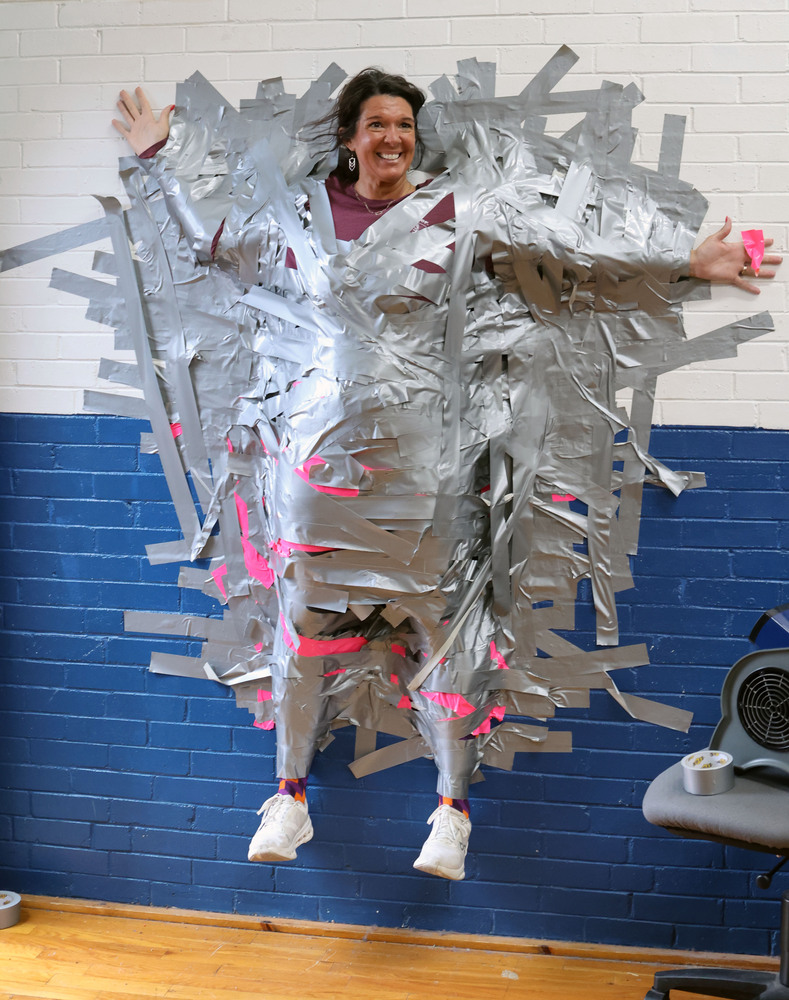
How many rolls of duct tape does it take to tape a principal to a wall?
Turns out it takes about 15, at least if you are Stephanie Shipley and every student in your school gets at least one strip of tape to add to your body.
Shipley, principal at Lincoln Elementary School, subjected herself to the activity as a reward for students turning in their Impact Aid cards by the district’s deadline.
“Everyone gets a piece and comes up here,” she said as she prepared for the event. This was Shipley’s first time to be taped to a wall and she admitted to being “a little anxious.”
Shipley stood on two milk cartons in the gym, spread her arms against a wall, and allowed Amy Wilcox, counselor, and Madi Maez, discretionary aide, to anchor her to the wall. Every student who was present on Oct. 30 piled into the gym and was given strips of tape by their teachers to help hold Shipley in place. Shipley estimated that about 250 students participated; the two kindergarten classes were on a field trip.
Evalyn Spriggs, fifth grade, was one of the first students to apply a strip of tape.
“I put it on her knees. It was fun,” Spriggs said, adding that she had been looking forward to taping Shipley to the wall.
Addisyn Green, fifth grade, said she put two strips of tape on Shipley, one on her leg and one on her arm.
“I just thought it would go better,” she said as to her choice of placement, adding that Shipley looked “kind of funny” but she thought that the tape would hold her up when the milk cartons were removed.
Kahne Scott, fourth grade, actually seemed to feel a little bad about taping Shipley.
“It felt like I was torturing her,” Scott said.
Jessiah Bernard-Gonzales, fourth grade, was the next to last student to add a strip of tape. He got his tape all tangled up as he stood in line waiting his turn and eventually was given another strip.
Bernard-Gonzales explained what the students were doing.
“We are taping Mrs. Shipley to the wall because it is fun,” he said. He planned to add his tape to one of her legs “because I want to put it there.”
Did he know why the students were doing this? “No,” came the reply.
Did he think the tape would hold her to the wall?
“Yeah, because there is a lot of tape. There are 232 pieces on her,” he said.
How did he know how many pieces of tape were on his principal?
“I can count,” he said, adding that he had counted all the pieces of tape.
After the last student had added the last piece of tape, it was time for the moment of truth. Had the students added enough tape to keep Shipley on the wall after the milk cartons were removed underneath her feet?
The students counted down and two boys were chosen to remove the milk cartons. Shipley’s staff stood close by to catch their principal in case the tape gave way.
The boys removed the milk cartons, the tape held, and Shipley was firmly anchored to a wall in the gym. Activity complete, staff members quickly began removing the tape and helped Shipley off the wall.
“My feet are asleep, but I am good,” she said once she was freed. “It was the longest 35 minutes of my life, but it was worth it.”
Shipley described the experience as “very strange” as some parts of her body felt constricted while others felt too loose.
“I was worried we would not have enough duct tape,” she said.
Samuel Kuykendall, fifth grade, was one who seemed to enjoy the experience.
“I wanted to leave her there all day,” he said after she was removed from the wall. “I’ve been waiting some years just to duct tape one principal of this school to a wall.”
Shipley said she chose the activity as a reward for her students meeting the goal of returning 90 percent of their Impact Aid cards by the district’s deadline.
“It was different than a pie in the face or throwing water at me,” Shipley said. “I wanted to make it something fun and different for the kids.”
Shipley said the goal was to get 90 percent of the Impact Aid cards back before the deadline, which the school exceeded. By the time students taped her to the wall, only 4-5 cards were still out.
“Getting the Impact Aid cards returned is huge for us,” Shipley said. “That money we receive from those Impact Aid cards goes back into our district, goes back into our schools, and also the district put out an extra incentive for the schools that met that 90 percent. They would have money put back into their instructional funds to go back into the classroom. So that was also an incentive for the students, knowing that we could get more things for their classrooms throughout the year.”
Besides all that, the activity was just something fun to do.
“So I just want fun for the kids at school. I try to make it fun. I try to reward them when they do the right thing,” Shipley said. “I think it just teaches them responsibility … that doing the right thing gets you rewarded for doing the right thing, whether it’s a tangible award or a non-tangible award.”
Shipley did not rule out repeating the activity.
“I can see the kids loved it, so I would 100 percent be all in,” she said.