
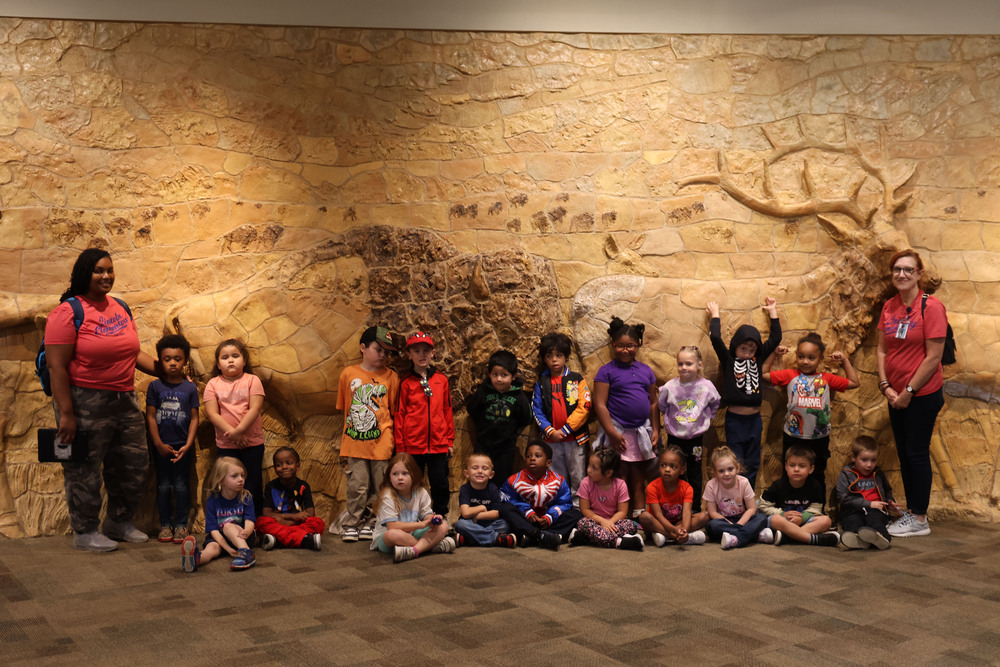
Ahzaun Reed may have said it best when he declared his trip to the Wichita Mountains Wildlife Refuge as “best day ever!”
Reed was one of about 35 kindergarten students from Lincoln Elementary School who recently visited the refuge thanks to a grant from the Friends of the Wichitas. The Friends offer $250 grants to schools to help offset expenses of transporting students to the refuge for a few hours of fun and learning.
For many students, it is their first experience in the great outdoors.
Refuge Ranger Quinton Smith explained why it is important for students to visit the refuge.
“So they are not scared of it, so they feel comfortable out here,” Smith said.
And the young visitors seemed to enjoy their experience.
They started their visit at the refuge Visitor Center where they were asked by Ranger Sage Gilbert what kinds of animals they had seen so far. Answers ranged from buffalos to cows to snakes to a dinosaur.
A dinosaur?
Gilbert said he didn’t think so.
After querying students about what animals they had seen, Gilbert showed them skulls and horns of animals that inhabit the refuge and explained the difference in the antlers. He also had students count the points on the antlers.
Then he showed them various animal skins and let them pet them. One boy held his nose when Gilbert held up a skunk skin.
Dream Chatman said she liked the fox skin best because it “felt like a sleep pillow”.
“I liked the white one (skunk) the best. It was swinging its tail and moving,” Luca Gomez said.
Gideon Parker also said he liked the skunk skin the best.
“The skunk was the best because it was my favorite animal,” he said.
Blayden Barnes said he liked the raccoon skin best because “I like raccoons”.
Once the students had examined the horns, skulls and skins, they explored the exhibits in the Visitor’s Center. Students gave the interactive displays a workout, climbed on some rocks and played with some antlers and a turtle shell.
One student eyed a diorama of a prairie dog with a coyote lurking nearby. Why was the coyote looking at the prairie dog? Well, the prairie dog might make a great snack.
“Eek,” the student said.
After thoroughly examining the exhibits, it was time to actually head into the great outdoors. Students loaded up on the bus and departed for the Holy City where they had a picnic lunch. After lunch, it was time to do some exploring and get a few lessons about wildlife from Smith.
Smith had the students line up and wave their arms over their head in a crossing fashion, explaining they were mimicking the way butterflies flap their wings. Then students stood on one foot the way some birds do to conserve heat, Smith explained.
Then came an impromptu lesson on poop. Students noticed animal droppings and Smith took the opportunity to explain the difference between cow poop and buffalo poop. (Bison pies contain more fiber and are less smelly than cow chips.)
Smith knelt down on the ground to examine some droppings while a group of students crowded around him. He picked up some dried droppings and broke them apart, explaining that droppings are made up mostly of grass and other nutrients.
One young girl picked up some dried poop and broke it apart to see what was inside, showing the two pieces to the photographer.
Then came the big find. Smith found a dung beetle inside some droppings and explained the role of such insects in the ecological system. Students hunched over and watched fascinatedly as the beetle scurried through the grass.
Done with the lesson on poop, Smith rounded up the students and marched them across the grounds of the Holy City to a wooden boat that is used in the annual Easter pageant story. The students piled into the boat and smiled for the cameras that documented their trip.
On the way back to the buses, Smith saw an Eastern collared lizard scampering across the rocks and took the opportunity for another impromptu lesson. He explained that male Eastern collard lizards, also known as mountain boomers, are bright blue with yellow heads. The females, one of which was nearby, are brown.
Several students offered their observations on what they enjoyed about the trip,
Barnes said he saw a buffalo.
“It was black and it had horns. It was right down the street,” he said.
“I saw a buffalo with horns and I saw a great big bull,” Parker said.
How did he know it was a bull?
“Because it was a statue,” he said, adding that he also saw a fox.
“I went to the wildlife refuge, walked around and spinned stuff (referring to displays in the Visitor Center). I saw a couple of bison, an elk and a wolf,” said Jaxson Bennett-Nayak. “I also liked everything.”
Smith would have been glad to know that Bennett-Nayak liked everything.
“Nature is a place for people to refocus and get away from it all. If they haven’t experienced places like this when they are young, they won’t do it when they are older,” Smith said.
Smith said refuge rangers can tailor their presentations to the needs of each group of students. They can take a hike or book an environmental lesson, or just take advantage of what the day offers.
“We take what nature gives us, like the dung beetle today. We learned about the micro ecosystem, and kids will explore. Adults won’t examine dung,” Smith said.
Smith said funds for the grants are provided by The Nature Store at the Visitor Center and from dues from the Friends of the Wichitas.
“One hundred percent of the money from The Nature Store goes back to the refuge,” Smith said.
Those interested in applying for a $250 grant may do so through the Friends of the Wichitas website at https://friendsofthewichitas.org/