
Should you ever find yourself without shelter in the middle of a blizzard, or suffering through a heat wave, students at Central Middle School will be able to help you.
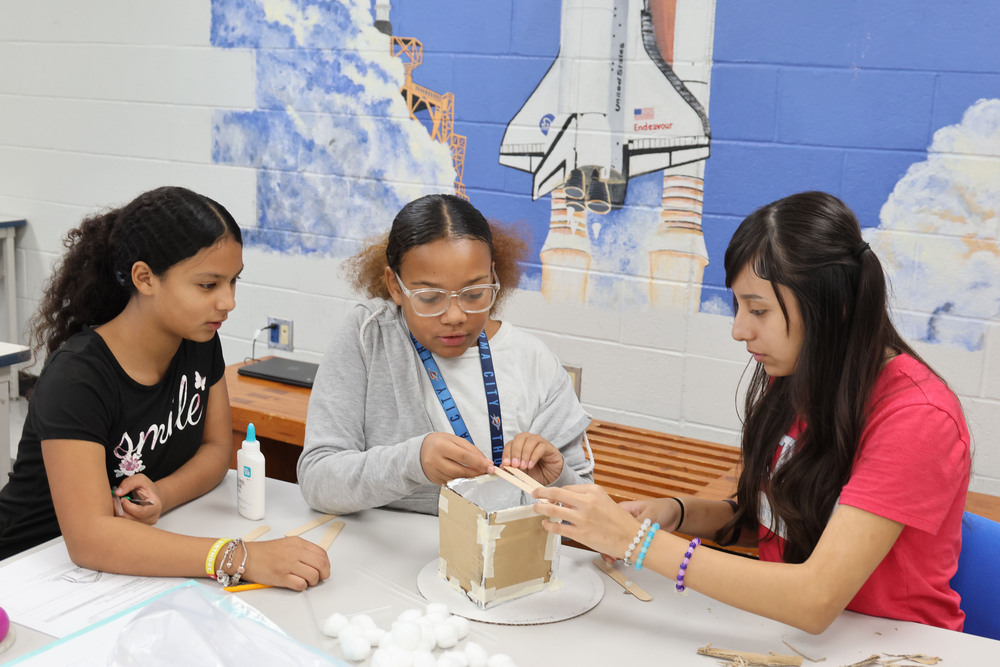
Students in Michelle Davila’s sixth grade science class wrapped up a physical science unit on particles, thermal energy, light waves, and conduction and insulation by building models of emergency shelters. Students could choose between building a shelter to protect themselves from a blizzard or to sustain them during a heat wave.
Although the weather scenario they picked dictated how they would build their shelter, everyone was provided with the same materials. Each team was given five 3x3-inch pieces of cardboard, four plastic straws, 30 cotton balls, seven inches of foil, six jumbo wooden sticks, tape, glue and as much newspaper as they wanted. Students had 30 minutes to build a shelter, but did not have to use all of the materials they were given.
“Something happened to these people, either a blizzard or a heat wave, and they lost their shelter. If it was a blizzard, they need some place warm quickly. They don’t have a lot of time to build it,” Davila told the students. “I told them when you are building an emergency shelter, you don’t always have the materials you need. You have to build it quick to keep them safe.”
Jessica Castillo and her group, including MiAngel Caldwell and Yessenia Rodriguez, tried to choose which design to use for their shelter from a blizzard. They used cardboard for the walls, which they covered with foil. The wooden sticks served as the roof, which was then covered in newspapers.
“We are using foil to keep the heat in and the cold out,” Caldwell said.
Why had they chosen the blizzard scenario?
“Because I love cold and I do not like to be hot,” Caldwell said.
The team of Amari Dickerson, Chad Johnston, Stanley Moore and Andrew Monroe also chose to build a shelter to protect themselves from a blizzard.
Johnston explained that the group was using cotton balls inside the house for insulation.
“The last layer should be foil,” Johnston told his teammates.
Johnston placed one of the straws at the corner of the house.
Why?
“I don’t know,” Johnston said.
“He’s trying to make it fancy,” Dickerson said.
“The straws are just for structure, maybe to make it stronger,” Johnston said. “Maybe it will be a watch tower.”
The team decided to use the wooden sticks for the roof, which they taped into place.
“Guys, we should stop using tape on the roof. We need cotton balls on the roof to keep the heat in,” Johnston said.
Davila noticed gaps in the walls as she inspected the structure.
“You have holes in the walls and the heat is going to go out. I think you forgot about the newspaper,” Davila said.
“Oh, yeah,” Johnston said, who then began tearing off strips of newspaper and securing them in the cracks.
Would the team survive a blizzard in their emergency shelter?
“Yes, we would survive,” Monroe said. “We’ve got the gaps covered up.”
Although the team of boys felt confident they would survive in their shelter, the girls were not so sure.
“No, because it is weak,” Caldwell said. “I just don’t think we are going to survive. We are going to freeze and then die.”
“It has gaps between the walls,” Castillo said.
Rodriguez agreed that they probably would not survive.
“It’s tipping and collapsing a little. It just might collapse,” Rodriguez said.
What would they do differently?
“The whole house. I would change the whole thing,” Caldwell said.
Instead of using their cotton balls to insulate the house, the girls used them to make snowdrifts around the outside of the house.
While most students chose the blizzard option, the team of Hunter Mcmanis, Leah Dewberry and Nevaeh Kelly opted to build their shelter to protect themselves from a heat wave.
“We thought it was better instead of a blizzard,” Dewberry said. “I like it cool. I can keep it cool inside and I don’t have to use so much stuff to keep it hot.”
She pulled cotton balls apart and spread them out before placing them on the cardboard walls.
“We don’t want to run out,” Dewberry said as to why she was conserving the cotton balls.
Because the walls kept falling down as Mcmanis tried to glue them in place, they decided to tape the walls together. When that didn’t work, they tried using the wooden sticks to brace them.
“These squares are so uneven. They are not the same size,” Mcmanis said as to why the walls would not stay in place. “They caved in.”
Mcmanis directed the construction of the shelter, giving tasks to Rodriguez and Dewberry. Sweat dampened his hair as he tried to get the shelter built before his time limit was up.
The group placed a layer of foil on the roof before covering it with a newspaper page. Eventually the entire structure was covered in newspapers.
“OK, we are good,” Mcmanis said as he threw up his hands after putting the last piece of paper in place as Davila called time.
“The outside of our house looks ugly,” Dewberry said of the finished product.
The shelter may have been ugly, but would they survive a heat wave with no electricity?
“I think we will survive,” Mcmanis said.
“Yes, pretty much,” Dewberry agreed. “Because we did what we said we would do. A lot of the materials we used will keep us cool. The tin foil would keep the sun off the shelter.”
Kelly agreed, saying the team did everything right.
Davila said she is a big fan of project based learning, because it helps students make connections.
“It makes connections to the real world. If they make a connection, they will remember it,” she said. “It gives them an idea of what engineers do every day. I love seeing when it clicks.”