
MJ Ingram, 11, was beaming from ear to ear.
“I reached down and did this and I tossed some at him and he ate it from my hand. He had a purple tongue. It felt like a dog and cat mixed together,” he said breathlessly.
Ingram, who attends Lawton Virtual Academy, was describing what it was like to feed a baby calf. He was one of about 1,200 Lawton Public Schools fifth graders who attended Farm Field Days at the Great Plains Coliseum in early September. Students got to see large machinery — really large machinery; learn about various grains and plants; see a tank full of fish; learn about farm commodities; pet a horse; and of course learn about — and pet — some farm animals.
The calf which had captivated Ingram was one of two in a pen at the entrance to the Coliseum where school buses dropped students off.
“The brown one is ignoring me,” Ingram said of the other occupant of the pen. “He shakes his head and walks away.”
Was this the first time Ingram had seen a calf?
“The only other time was in Minecraft (a video game),” he said. “They are actually cool. They look better than in Minecraft. He tried to eat my hand.”
After checking out the two calves, students were ushered into the Coliseum where they rotated through several stations as they learned about the role of agriculture in everyday life.
One stop was the farm machinery display. All of the machinery, from tractors to combines to swathers to hale balers, is equipment used on Sullivan Farms east of Lawton. Representatives from Parallel Ag in Chickasha were on hand to explain the oversized machinery to students. Aaron Elam, applications director for Southern Plains for Parallel Ag, said the equipment provided a timeline of farming, starting with the tractor and ripper that prepare the land, then the planter to plant seeds and the sprayer to control weeds. Elam also showed students three different types of hay bales: large round bales, small square bales and large square bales. Also on display was a large drone, which is used to check the fields.
Alex Tieyah, Cleveland Elementary School, pushed against one of the large square bales of hay.
“I think it’s pretty cool,” he said of the exhibit, adding that his favorite piece of equipment was the drone.
What had he learned about farming?
“They have to dig and then they have to put the seeds in. They have to cut the hay bale to make food,” he said.
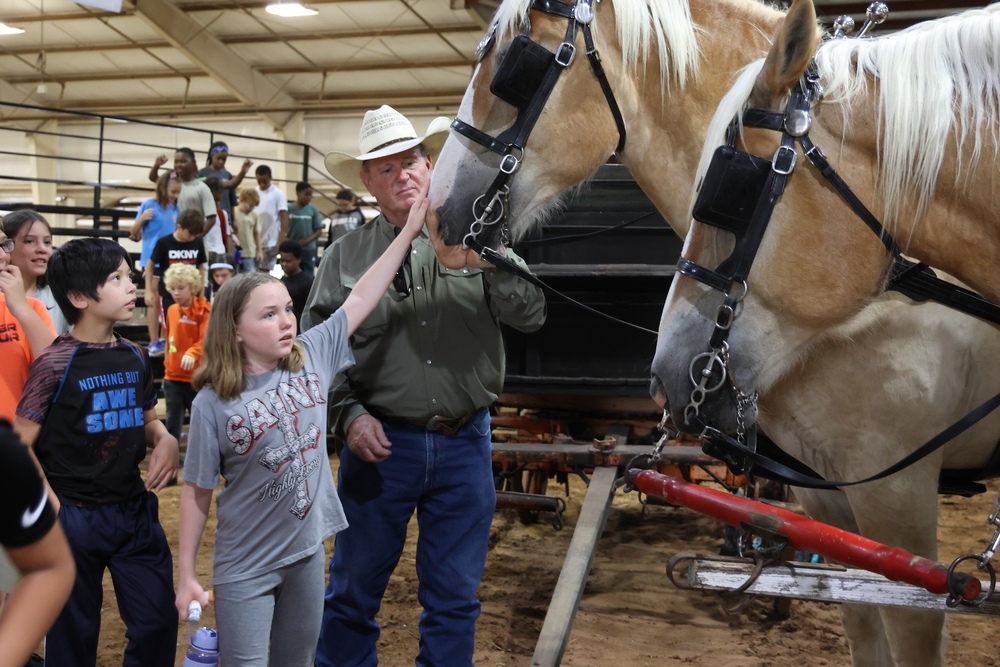
No farming operation would be complete with a horse or two, and River Mitchell from Mitchell Ranch in Fletcher brought plenty, including Billy and Bob, two Belgian draft horses. Mitchell had students guess how much the horses weigh, with 2,450 pounds each being the correct answer. Mitchell also passed around a horseshoe from an average horse and one from a Belgian draft horse.
Aubrey Richardson, from Hugh Bish Elementary School, was one of the first to handle the giant horseshoe, guessing it weighed 100 pounds.
“It was really heavy,” she said. “One was really big and one was really small. One was really heavy and one was really light.”
What had she learned about horses?
“They can be really big. The horseshoes can be really heavy sometimes.”
What do horses do on a farm?
“They might do tricks with their owners and they ride around and have fun,” she said.
As students exited the arena, they were given the opportunity to pet Billy or Bob, which was a first for some students.
Students from Eisenhower Elementary School were learning about various types of grain from Rae Sharry, area agronomy specialist in West District for OSU Extension Service. Basketfuls of various grains, including rice, oats, wheat and sorghum were displayed as Sharry talked about each one.
William Rosas, from Eisenhower Elementary School, said he was interested in what grains could be fed to horses. Rosas said he used to live on a farm in Utah where his family grew wheat for hay and raised cows, sheep and chickens. Even with a background in farming, Rosas said he learned a few things at Farm Field Days.
“I didn’t know that cotton grows on a stalk and I didn’t know how oats grow,” he said. “I didn’t know that peanuts grow underground. I can learn about new stuff to make hay.”
The sweetest lesson of all may have been at the U.S. Ag and Commodities station where each student was given a Starburst to illustrate how many daily items come from agriculture products. Robert Payne, a county executive director with the USDA Farm Service Agency, said a Starburst is made up of basically three ingredients: vegetables, fruit and animal products. Starbursts contain gelatin, which is derived from collagen, which comes from the lower legs of cows and pigs’ ears. Citric acid gives the candy bites their sour taste while sugar cane or sugar beets provide the sweet taste. Starbursts also contain corn syrup, all of which are ag products.
Payne also told the students they were wearing ag products, such as cotton in their jeans and T-shirts.
Shannon Offor, from Pioneer Park Elementary School, said she learned that a lot of products contain cotton, like Band-Aids.
“A lot of other foods have vegetables that I didn’t know,” Offor said, adding that Starbursts used to be her favorite candy. She learned that the juicy squares contain fruit and vegetables. “Starbursts are tasty and I’m eating fruit.”
She said her favorite station was seeing the horses, but that she learned more about ag products at the commodities station.
No trip to the farm would be complete without seeing the animals, and plenty were provided for just that purpose. FFA students had pens set up for two different types of cows, a couple of small goats, a pig or two, some sheep, a bunny and some chickens.
Kade Vargas, from Almor West Elementary School, got to pet a lamb.
“It felt really soft, kind of like a pillow,” he said. “I thought it would feel like hairless skin.”
Cason Rower, Almor West Elementary School, said he enjoyed petting the rabbits and had learned several things about agriculture.
“I learned that Starbursts are made of vegetables and about what is in canned foods,” Rower said. “It is nice to know if foods are good or not. It is a nice place in general to learn.”
Dreya Clark, Almor West Elementary School, said she also learned a lot about agriculture.
“I thought it was a pretty fun experience and I learned a lot about farming, like where we get our clothes,” she said. “It told me a lot about what I’m eating and the process it goes through. It is hard to make the food.”
She also was enjoying petting the animals, noting there is “a lot of poop on the ground.” She said her favorite animal to pet was the lamb.
“It feels nice and comforting. It reminds me of counting sheep. It is even more fun because I get to do it with my friends,” she said.
JR Gibson, president of the Lawton FFA, said Farm Field Days are important because students are introduced to the role agriculture plays in their daily lives.
“They use a lot of things day to day that are ag products they don’t know they use,” Gibson said. “A lot of individuals here today are future ag leaders and they don’t know it yet.”
Gibson said one of the goals of Farm Field Days is getting fifth graders interested in agriculture so they will want to join the 4-H program in elementary school.
“We get mixed reactions,” Gibson said. “Some kids are nervous when they get here. They think the animals stink. Once they get their hands on them and touch them, they change their mind. They are just learning what ag is.”
After a long morning of learning about agriculture, students had an opportunity to consume some ag products when they were served a hamburger lunch.