
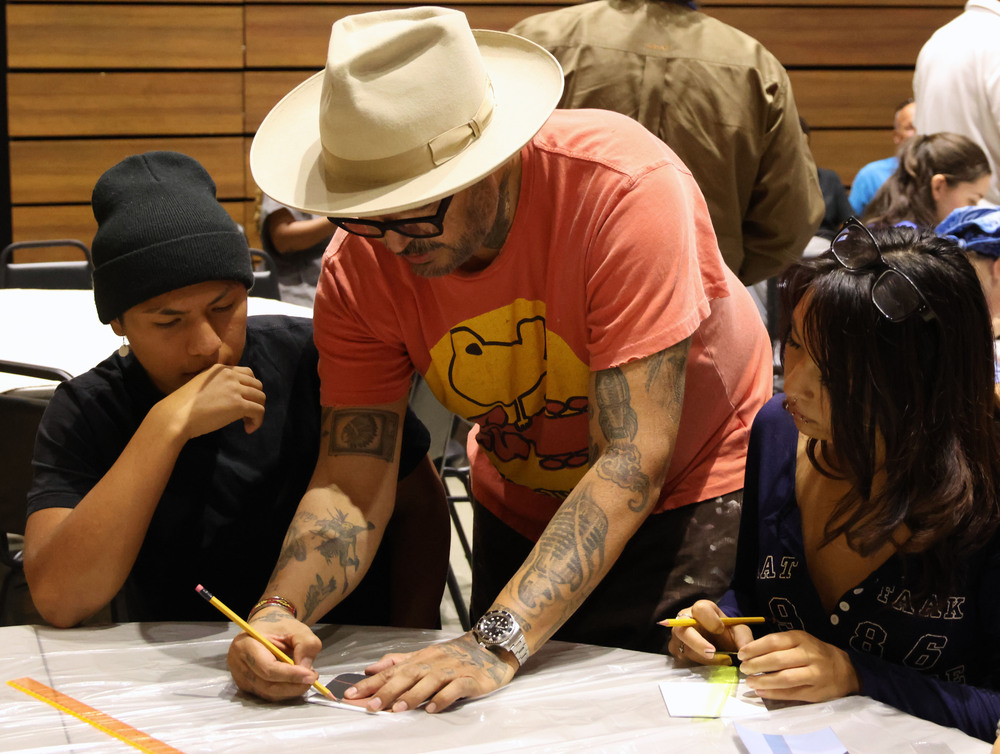
About 20 Lawton Public Schools students became artists for a day when they attended an event at the First Americans Museum in Oklahoma City.
The LPS students joined students from Mustang, Ponca City and Stillwater for an art session with artist and screenwriter Steven Paul Judd. Judd, who is of Kiowa/Choctaw descent, is from Lawton and took a nontraditional career path.
“I wanted the students to hear his story and how a nontraditional path can still get you where you want to go. You can’t forget about your dream and where you want to be. Keep focused and keep working and you’ll get there,” said Raylisha York Stanley, Indian Education Liaison for LPS, who helped organize the event.
Judd shared that nontraditional career path with the students before he led them in an art project. He said that he received a scholarship to Kansas University to be a speech pathologist.
“I didn’t even know what that was,” he said, adding that he gave them their money back and called the University of Oklahoma.
“Can I go to college there?,” he asked. “They said, ‘yeah.” So he transferred to OU and pursued a degree in communications.
“I kept going to school for nine years to get a bachelor’s degree,” he told the students.
He ultimately ended up in Los Angeles where he wrote several episodes for Disney’s XD Comedy series “Zeke and Luther.” When that job ended, he came back to Oklahoma where he painted and made shirts. At one time he also co-wrote for Marvel Studios’ series “Echo.”
“I didn’t go to school to write. It is really cool. It is so nuts,” he said, marveling where life’s path has taken him. “My goal is to direct my own movie.”
Not only is Judd a screenwriter, he also is an artist and fashion designer. In November, he has a shoe design from Nike coming out.
Stanley said she wanted the students, who are members of the Kiowa language or trial industries classes at the Life Ready Center, to tap into their culture with Judd. She said she wanted them to “see someone in their culture become successful and to be able to work with them hand in hand” in creating an art project.
The project involved students taking a colored square of paper at random from those provided, then taking a white square of paper. They were then given a dab of paint on a paper plate that matched the colors on their white square. Students were asked to replicate the colored squares they were given with the white square and paint. Judd did not tell them what the finished art project was.
“You cannot mess this up so bad we cannot fix it within seconds,” Judd told the students, most of whom confessed to not being artists.
Isabella Marlow and Aubrey Anquoe said they did not consider themselves to be artsy, crafty people. Nor did they know the field trip involved an art project.
“I’m just here. I’m learning how to draw though,” Marlow said as she painted her square. She said she wants to go into the health field and be an ultrasound tech or maybe an immigration lawyer. Anquoe said she wants to be a physical therapist, or play basketball.
“It’s fun; it’s not hard,” Marlow said of the project. “I think it is going to be a big puzzle.”
Shaianne Poolaw said she painted three squares; she is a daycare worker and does a lot of art projects in her job.
“I didn’t know it was going to be this simple. It is just this line and coloring it,” she said. “I feel like he might post them somewhere.”
“I’ve never really been an artist. I’ve never really expressed myself as an artist,” said Sirvantes Ferguson. “The project is really easy if you listen to the directions and follow the picture. I thought we were going to walk around and enjoy the museum.”
Monte Goodson was taking her time and being very precise in painting her square.
“I like painting sometimes. I like doing small things,” she said, adding that she took art in the eighth grade. “I feel like when I do art, it has to be exact. It has to match.” She guessed that Judd was going to put all the squares together and make a big picture.
Indeed, making a big picture was exactly what Judd had in mind. Each of the 150 squares was numbered on the back to show its place in a picture of a Native American with a headdress on.
Although Stanley did not get to paint a square, she did put the first square into place in the project.
“That is really exciting,” she said.
Since the students did not get to stay long enough to see the finished project, Judd said he would bring it to Lawton at some point to show the students. After that, the artwork will be on display at the First Americans Museum. The mural will be on loan to each of the schools involved in the project and to the Oklahoma State Department of Education.
Several students said they hoped to bring their families to the museum to see the finished product, and that includes Stanley, who wants to take her grandson to see what Gigi did.