
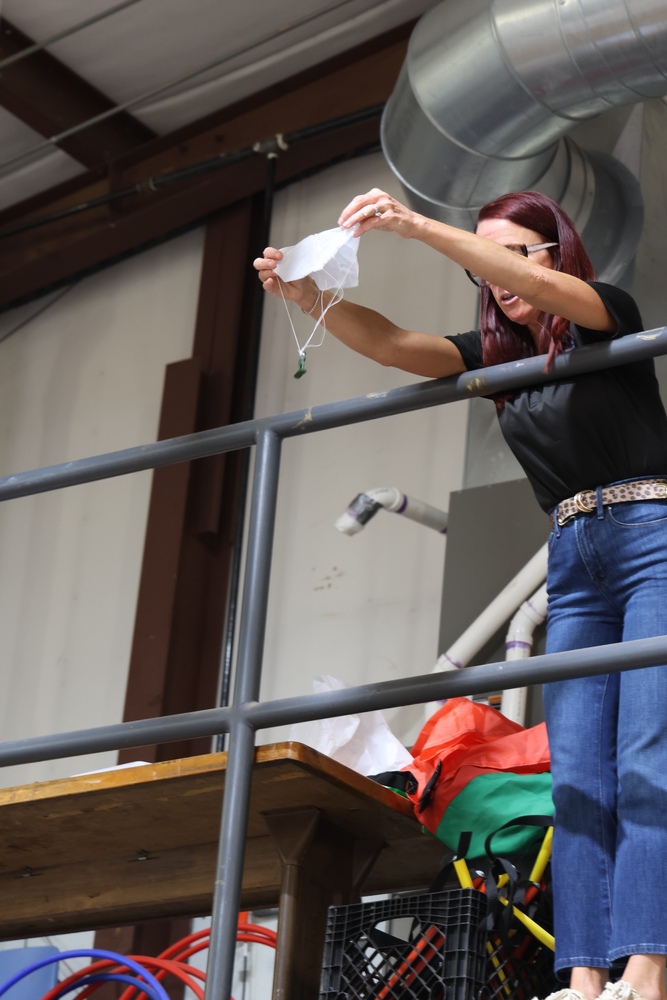
It was a tough day to be a potato or a plastic army man at the Lawton Public Schools STEM professional development training. One got impaled by foreign objects and another was dropped from the second floor by some hastily designed parachutes.
Few survivors were reported from either exercise.
The two activities were conducted by Dorinda Risenhoover, education coordinator for NASA OKSG at OSU, during professional development sessions for Makerspace teachers at the STEM Gym before school started. The goal was to help teachers gain a better understanding of how to fill out engineering notebooks, but who says you can’t have a little fun while learning.
The first exercise involved making a five-layer spacesuit for a Spudnaut, i.e. a potato. The challenge was to research and design a suit to go around a potato that would be impaled with a straw, box cutter and Xacto knife to see when the potato was penetrated.
Mike Moretz, Makerspace teacher at Woodland Hills Elementary School, said his team used tin foil, bubble wrap, rayon material, a plastic bag and wrapping paper to protect their Spudnaut.
“The order was very important,” Moretz said, because they wanted the outside to absorb the foreign objects.
“We only had three cuts on our potato, so we did pretty good,” Moretz said.
The second mission was seemingly simple: see how long it takes a parachute to glide to the ground with a plastic army man attached.
First, teachers had to research how to make the parachute. Then they had to create an engineering notebook complete with a drawing of their design before selecting which materials. Lastly, they tested their design by dropping the army man, complete with parachute, from the top floor of the STEM Gym.
The parachute that glided the longest would be declared the winner.
Part of the challenge was how to attach the plastic army man to the parachute.
“I wrapped him around the string and strangled him,” Tina Llopis, Makerspace teacher at Almor West, said laughingly. “I hope he stays.”
Some teachers, like Samantha Martin, went for simple designs. She used a plastic shopping bag and some yarn, explaining that her research showed that a dome shape would be good to try to catch the most air.
Was she pleased with her design?
“No, but it is what I have. Let me cut a hole in the top,” Martin said after testing her design.
“It creates an air vacuum directly in the center of the bag so it will stay afloat longer. I eyeballed it due to time constraints,” she said of where she opted to cut the hole.
Kara McCarthy, Makerspace teacher at Freedom Elementary School, chose painter tarp, fishing line, reinforcement circles and a paper clip as her materials.
“I wanted the lightest material. The stickers are to reinforce the holes I’m going to make in the tarp for the fishing line,” McCarthy said. “I looked up soldier parachute drops. They had different shapes for the parachutes, including a circle and an octagon. I’m going to try for the octagon. I think it will make a better dome shape when it drops.”
While most teachers eye-balled their work, Jordan Zemlin, Makerspace teacher at Freedom Elementary, used a yardstick to carefully measure her materials as her fellow teachers mocked her for being so precise.
Then it was time for the moment of truth. After all the parachutes were hauled to the second floor of the gym, Risenhoover dropped them one by one.
McCarthy’s glide time was 4.03 seconds.
“Right now it’s first because it got stuck (coming down),” McCarthy said. “I think that’s pretty awesome.”
After all the army men had been dropped, Zemlin’s was declared the winner with a time of 4.23 seconds.
“It was the lightest material. I tried to make the strings as even as possible so it would be balanced. I measured and tried to make it even,” she said, saying the measuring helped.
Moretz said he would definitely do the parachute activity with his students this year and might attempt the Spudnaut one. He said the activity with the engineering notebooks will be helpful for the annual cardboard boat race event.
“We will probably work on the engineering notebooks. It goes hand-in-hand with the boat design notebook,” he said.
He said students are interested in building boats for the cardboard boat race but drop out when he shows them the engineering design notebook, which is part of the exercise.
“I like to win. Kids like to win. If you don’t put in the work on the design notebook, it will sink,” Moretz said of the boats. “This year we will redesign again and make it shorter, a lot shorter.”