
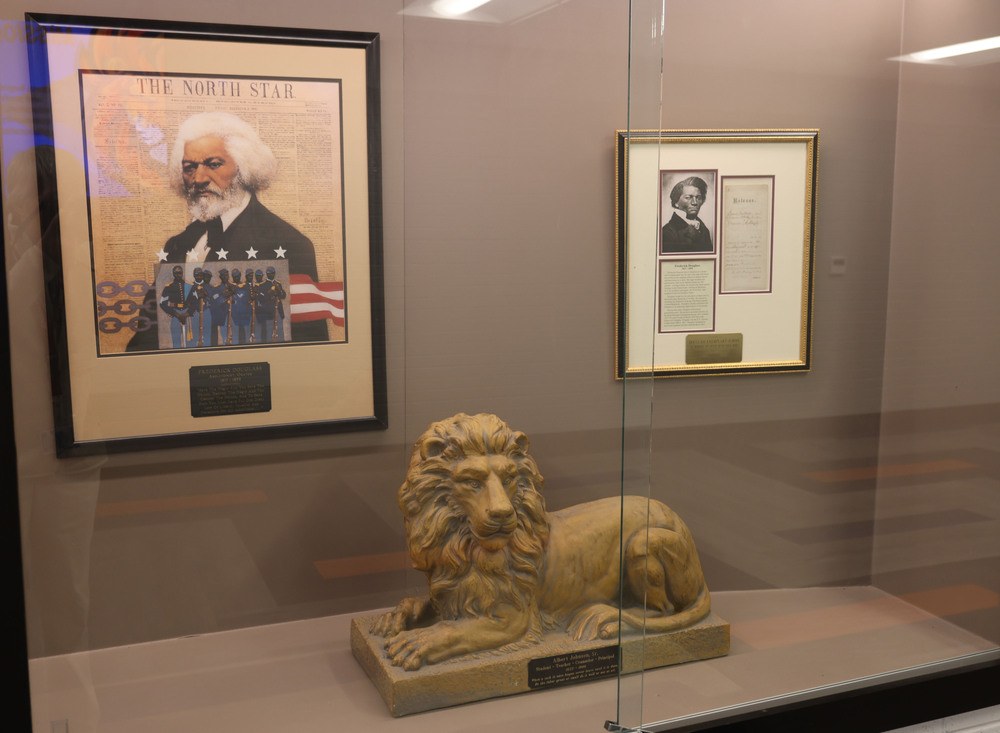
Lawton educators have re-discovered a document signed by Douglass Learning Center’s namesake, Frederick Douglass.
What is now Douglass Learning Center at East Gore Boulevard and Albert Johnson Sr. Avenue is the third incarnation of the school that has existed just off today’s downtown area since the early 1900s. This building, which opened in 1931, operated as an all-black school for decades, educating generations of families before it was closed at the end of the 1965-1966 school year as part of Lawton’s desegregation efforts.
Lawton Public Schools has kept the facility in almost constant use since then, to include today’s Douglass Learning Center and the Albert Johnson Sr. Conference Center. History remains important: there is an active alumni association, the building itself pays homage to history through displays, and scores of former students still tell stories. Its historical significance was honored in 2008 by placement on the National Register of Historic Places.
Even the school’s name is a nod to history. The school’s namesake is famed abolitionist, orator, author, newspaper publisher and preacher Frederick Douglass, one of the leading voices in the anti-slavery movement of the 1800s.
That’s why school alumni were thrilled by the acquisition of a document signed by Douglass.
Dr. Regina DeLoach, LPS director of student success and resources, said the document was donated by the late Julie D’Amura.
While Julie D’Amura and her husband Thomas made their home in Arlington, Texas, they once were Lawton residents. DeLoach said Julie D’Amura was an avid collector of the signatures of famous people, and she had a transfer deed signed by Frederick Douglass in her collection until she donated it to Douglass Alumni Association sometime in the mid- to late 1990s.
Thomas D’Amura recently called Douglass School to see if his late wife’s donated document was still there. He didn’t want it back; he just wanted to make sure it was still at the school, DeLoach said.
Douglass staff had already begun an unsuccessful search when DeLoach got involved.
“I started looking for it, but I did not see it,” she said, explaining she looked in places such as old cabinets and in old school files, ultimately bringing LPS Director of Fine Arts Charlotte Oates (who works at Douglass) into the search.
Discovery came by accident.
“I happened to be looking at the alumni trophy case, thinking maybe someone had put it in there,” DeLoach said.
They had. DeLoach said she was happy to tell Thomas D’Amura the news.
“I texted a picture to him,” she said, adding D’Amura was ecstatic. “He was excited. I was surprised and happy.”
The document – framed with a picture of Frederick Douglass and a short bio of the noted abolitionist – is small but mighty because of the handwriting it carries.
It is documentation showing an offer of land grant, from James Fullerton and James White, trustees to Terence A. Duffy. It was recorded for the land records of the District of Columbia, dated the 10th day of August, A.D. 1881, with the names, dates and location all filled in by Douglass. He then signed his name at the bottom as part of his job as the recorder of deeds, a position he had been named to by President James Garfield only three months earlier.
A footnote: Douglass served as recorder of deeds from May 1881 to August 1886, after serving as the nation’s first black U.S. marshal (also for the District of Columbia) from March 1877 to May 1881.
DeLoach said it all means that Douglass Learning Center and the Douglass Alumni Association now know where the framed document is and can celebrate physical proof of their school’s namesake. And that is great news for the community, she said.
“There is a lot of pride there,” she said, of the school’s reputation and significance through the decades. “It teaches us to value the past.”