
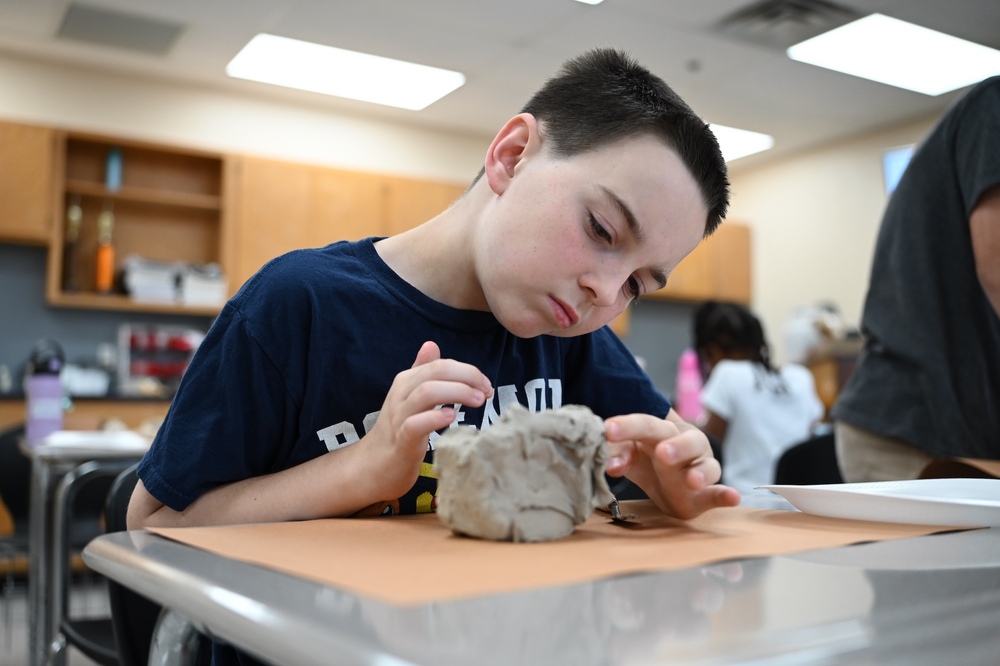
Katie Moon wants to give her students a sample of the traditional arts and crafts Native Americans enjoyed.
That meant the fifth graders got to play in clay and make ribbon shirts in colors of the rainbow, before adding their favorite hues to what had been plain gray pottery.
Moon, assistant principal at Sullivan Village Elementary, spent June teaching a section on Native American Arts at Lawton Public Schools’ Makerspace Summer Camp. For students, it was a chance to stretch their artistic muscles, bringing their own ideas and style to traditional arts.
Moon went light on her directives. For pottery, she explained why and how clay was formed into pottery that was pretty and functional, then turned the students loose to create what they wanted – not what adults thought they should make.
Each art session was introduced by a story or lesson, as students molded clay, wove beads to make snake key chains, and created ribbon shirts. The stories came from tribes all over the nation, giving students a chance to learn the differences in tribal cultures.
In pottery class, each student started with about two fists worth of gray clay.
“Make whatever you want,” Moon said, pointing to items that would help them, such as tools to cut or carve designs, and containers of water to even up the end product.
Students quickly learned to go light on the water: if your hands are dripping clay – at least one student had that problem – you used too much water, Moon said.
Student works reflected their diversity. In some instances, it also revealed the fact that some choices couldn’t be achieved in the short class time.
Daniel Wood worked carefully at his desk to create a miniature knight. While the figure remained the same, the knight’s job description changed several times over the morning.
“He’s a dragon slayer; look at the bones,” Wood said of his final decision, pointing to lumps of clay at the knight’s feet.
Once the knight was fashioned, Wood began making weapons, then a helmet and shield for protection.
“I like bows and arrows. I like swords and I like all kinds of weaponry,” he said, explaining he had made one knight out of plastic bricks and wanted to try it in clay.
Preston Powell had another goal in mind.
“My own plate, so I don’t have to share,” he said, working carefully to create a heavy plate from the clay.
Richard Resler used his clay to create a pot, one that started out plain gray, but sported almost every tempura paint color possible by the end of painting day. He grinned as he added more paint, explaining he likes colors.
Kimber Herman was thinking of her mother when she created a pot with inch-high posts inside. The posts had a purpose: each would hold a ring.
“My mother likes rings,” Herman said.
Riyan Meredina was more laid back.
“Blob guy,” Meredina said, laughing as she described her initial project while she continued to weigh options (she ultimately decided on a pot).
On painting day, Meredina carefully mixed white with maroon to create a beautiful shade of pink for her pot, enhancing it with a rim of bright yellow.
Jabali McFadden also changed his mind several times, ultimately deciding to go with small pieces to show his interest in various things, including balls and other forms.
“Squares,” McFadden said, nodding as he added bright blue paint to the forms on painting day.
Ziabella Ragland also changed her mind, starting out making a mask as she carefully mashed the clay to make eye holes and a nose, before turning her clay into a hat tree stand.
Addilyn Trantow stood firmly by her initial plan: a dog. By the end of class, her dog was fully formed, laying in a bed with a water and food bowl nearby, the result of careful work with cutting tools. Angela Gonzalez also stuck with her first choices: creating a turtle, then a pot with carefully carved designs. By the end of painting day, the green turtle had a brown shell while her pot was bright white, blue and orange.
The snake key chains were a much neater craft (no clay involved), but just as creative as Moon gave directions to arrange the colored beads on their desks to create their patterns, before showing students how to use a long piece of sinew to weave the beads together.
Their use of color came into play again two days later when students made ribbon shirts.
The idea: create a small piece of ribbon work, using pieces of ribbon in rainbow colors and a wide variety of patterns and widths. Once done, Moon sewed the pieces onto sweatshirts.
Students used their sense of style, selecting whatever color of ribbon they wanted and cutting it into lengths to lay it on a cloth background. Afterward, they glued the ribbon into place until Moon could sew them.
As with his pot, Resler used every color he could get his hands on, but still had time to give his tablemates a lesson in how to properly fasten the pieces.
“Put a dot,” he said, showing how to put a small dab, then spread it out so the glue wouldn’t soak through the ribbon. “Like this.”
Trantow had sky blue alternating with a patterned ribbon, while Gonzalez changed her mind partway through her work.
“Oh, my, a mess,” she said, reorganizing her ribbon pieces.
Makerspace Camp is provided by Lawton Public Schools in partnership with Arts for All Summer Institute.