Students at Makerspace Summer Camp have got the whole world in their hands — thanks to some string and newspapers, glue, a balloon and paint.
Students created their own globes as part of a class on mapping where they also learned about different types of maps, legends and how to read a compass. The most intense project though was creating a globe.
Ivan Guardiola explained the process: “Today I’m putting some string onto a balloon. Tomorrow we will pop it. You dip the string into some glue and take it out of the glue and put it on the balloon,” he said. “I like the part where we could blow up the balloon.”
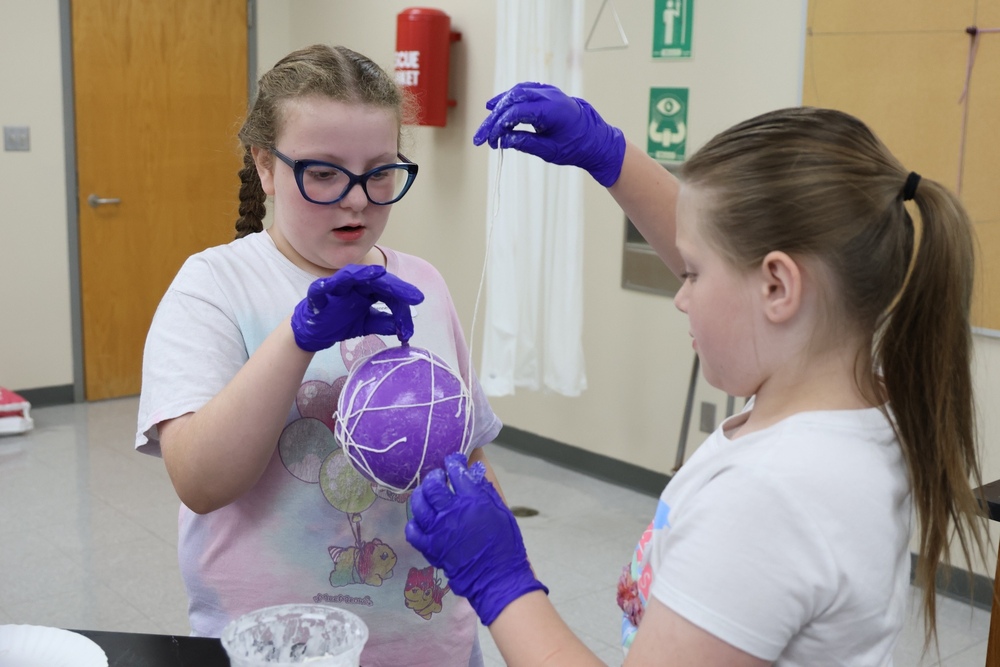
Creating your own little world turned out to be a messy business with students wearing blue gloves as they applied the glue-soaked string. The task seemed laborious to some, while others needed a little help in holding the balloon steady.
Elizabeth Hennessee and Andersyn Smith decided to help each other with the project.
“We are using teamwork. She is good at putting on the string and I am good at holding it still,” Hennessee said.
“Since it would be way faster,” Smith chimed in.
“It was taking too long,” Hennessee said.
“We usually cover the string all in glue and lift it out and wrap it around the balloon,” Smith said.
“It is supposed to cover the whole globe until we can’t see what color it is,” Hennessee said.
“It’s like spaghetti,” Smith said of working with the string.
“Then we will pop it tomorrow and paint it,” Hennessee said.
It seemed as if it would indeed take seven days to create the world, so coordinator Garrett Mitchell decided to speed the process up by switching from string to strips of newspaper to cover the balloons, a change which Hennessee and Smith seemed to approve.
“The paper is easier to wrap around than string,” Hennessee said.
“The string is thicker, but not longer,” Smith said.
“It’s less messy,” Hennessee said of the strips of paper.
Once all the balloons were covered in string or strips of newspaper, they were set aside to dry for the night. When students came the next day they carefully popped and extracted the balloon, leaving a round shell on which they would paint their globe.
“We are going to paint the earth now. I’m excited,” said Jaidyn Walker. He painted the globe green for the earth and white for the clouds. “The brown could be for the dirt,” he said.
“I made Antarctica,” said Abrian Peters about a white splotch on the bottom of his globe, on which he also was making Oklahoma and Texas. “I had to paint the whole world and then put the states in.”
“I did North America. I’m going to do Greenland, then do the other half of the world. I think Oklahoma would be right there,” said Franciso Miranda, pointing to a spot on his globe.
Once the globes were painted and set aside to dry, students made their own Plaster of Paris so they could form their favorite state on a paper plate.
Walker said he was going to make California because it is his favorite state, even though he has never been there.
“It just feels like a natural name to say,” he said of California. “It feels normal.”
Zaiden Peratla said he was going to make New Mexico, because that is where he was born. He also pointed out another benefit.
“It basically is a square,” he said of the shape of the state. “It was pretty hard because it (the Plaster of Paris) was all sticky. I cut a little bit of this part off,” he said of the lower left corner.
Once Walker tried to shape California, he changed his mind and switched to Oklahoma.
“I changed my mind about the state. I wanted to pick a state I could remember the history of,” he said as he used a marker like a rolling pin to get the shape just right.
“I’m trying to make it as straight as possible. I tried to make the wrinkles in it,” he said as he used his fingers to make the borders. “It reminds me of dough you use to make cupcakes.”
Mitchell said he wanted students to learn life skills, like how to read a map.
“Not so much that they can take an atlas and go somewhere,” Mitchell said. “But the sort of things to look for on a map. How borders are drawn, how perspective is an important part of reading a map, how things can be distorted on a map.”
What did students like best about the class?
“Getting dirty. I like getting dirty,” Hennessee said.
“I enjoyed learning a lot of new things. I get to do all kinds of different activities, and it’s super cool. And you get to get your hands dirty and make a mess,” Walker said.
Makerspace Camp is provided by Lawton Public Schools in partnership with Arts for All Summer Institute.
<