
Students at MacArthur Middle School didn’t let a little cold and wind keep them from testing their rockets.
They were a little winded after chasing down those rockets when they landed, though.
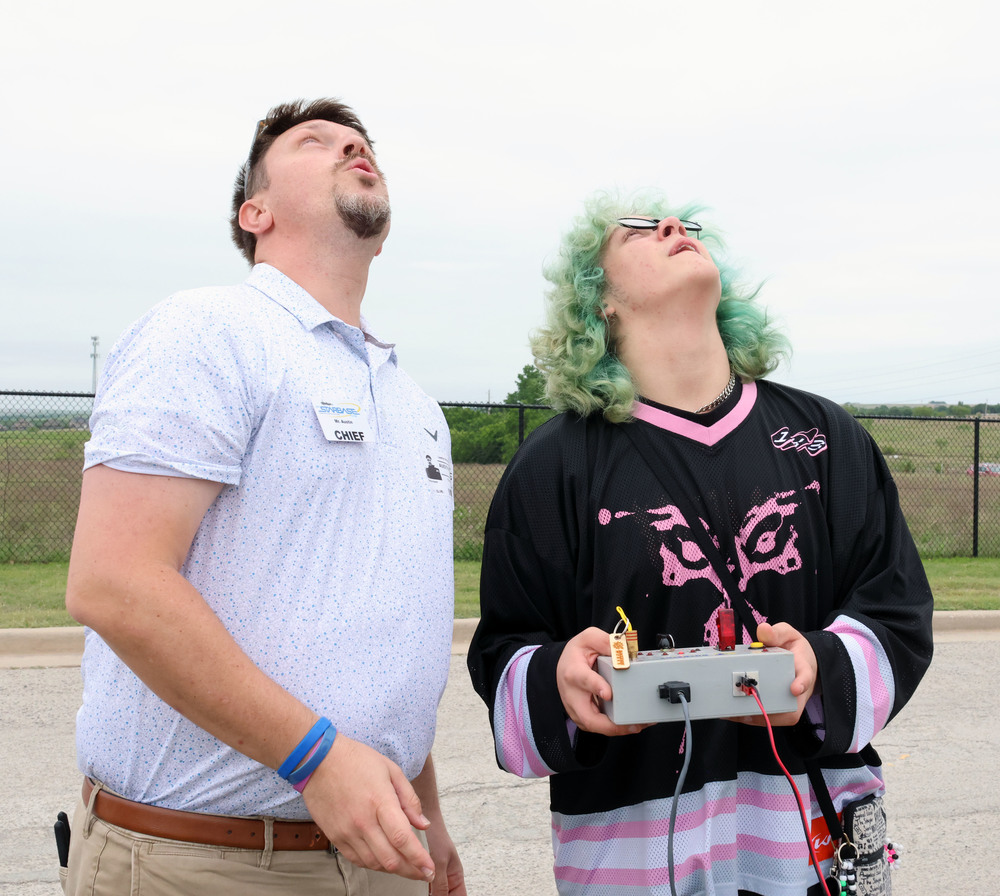
Educators from Fort Sill’s STARBASE recently led five students and their teacher into the parking lot on a cool, windy afternoon to fire off rockets that students had spent two previous afterschool sessions building. While educators saw an exercise that combined aspects of science and math in a fun way, students saw a fun end to an interesting class project.
Not only did students have to follow directions to build their rockets and understand why the mini-engine/propellant could lift the rocket into the air, math could help them calculate how far those rockets went into the air, based on where their rocket landed.
The weather did throw in some variables. While the rockets shot straight and true into the blue sky overhead, they were carried south – far, far south – once their parachutes deployed.
STARBASE Director Steve Schraner, new STARBASE instructor Austin Bowling and Lawton Public School teacher/class sponsor Kavis Murry said the idea was to show students that science and math can be fun and have wide applications. Each educator brought their own expertise to the class. Schraner is a retired LPS principal, while Murry is a computer science teacher familiar with coding and Bowling is a meteorologist.
Each played a role in moving students closer to launch time.
While Schraner went outside to prep the rocket launch pad, Bowling was inside with students, coaching each through the process of installing propellant into the slender tubes that formed the rocket bodies.
Most students had two rockets: one about a foot tall; the second, almost twice that size. They used the same technique on each: unscrew the bottom fins, insert the propellant packet, put the fins back on.
Adults didn’t just supervise. Schraner, Bowling and Murry had rockets they launched, to varying degrees of success. Schraner’s was the first into the air, so he could illustrate the launching process to students while testing the launching system. What followed were launches, near launches and failures.
Nature played a role, and Bowling noted he hadn’t taken the cold wind into account.
Mother Nature wasn’t the only problem: there were several misfires on the launch pad. Some didn’t fire at all (wiring problems); one misfired (propellant wasn’t far enough in the tube); one failed spectacularly when its propellant ignited, but didn’t push the rocket into the sky.
That was okay. Students said the main point of the exercise was to “see if we did it right.”
Eighth grader Liam Vanderheiden said he enjoys the STARBASE program because it is visual and hands-on.
“Science class is guided notes,” he said, explaining that actually seeing concepts in action has piqued his interest in science and math. “I’m learning a lot with the process.”
Vanderheiden said the program is meeting its objectives.
“We’re learning, better than in science classes,” he said, confidently predicting rockets would go at least 60 feet into the air and his would go the highest.
Students tried to remember what they had been told when they finally went outside. Schraner was full of warnings: Don’t touch the wiring on the firing platform; everyone clear the platform when the rockets are ready to launch; don’t touch the base of the rocket after it returns to earth.
Liam Howard had taken mental notes as Bowling helped him load the propellant into his rocket. Bowling started as he did with each student: removing the parachute inside the rocket body so it could be carefully wrapped in its cord to ensure release when it was time.
Howard’s rocket got great height, but his was the first to encounter a chute failure, allowing the rocket to plummet to earth. The rocket survived with just some “road rash.” It also gave its owner some exercise: Howard had to trek to the far south end of the parking lot to retrieve his rocket, where it was blown by the wind.
Seventh graders Lucas Maldonado, Jonathan Rodriquez and Gene Terrell had varying degrees of success, depending on whether their rocket launched and whether its chute deployed, and just how far away it landed.
“This is so fun,” said Rodriquez, who arguably had the longest flight because his rocket landed by the school’s flagpoles, far south of where it left the ground.
Murry had an inkling of just how successful the STARBASE program would be.
“I did this program myself in fifth grade,” he said.