
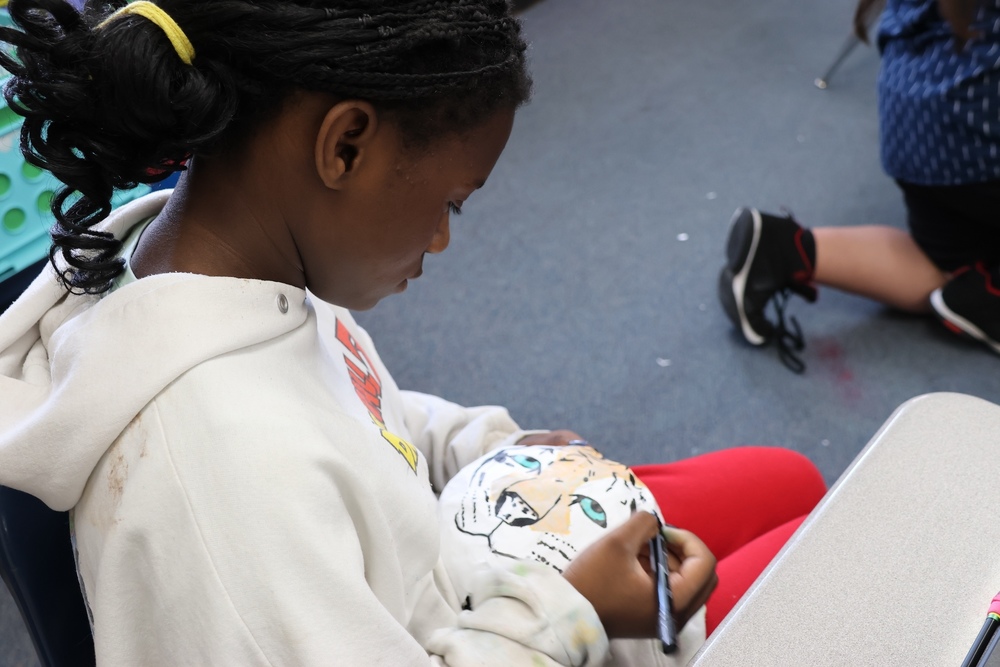
The beginning is messy, but the result is a unique, colorful work of art.
And, you get to show off what you know about another country.
The fifth-grade students of Whittier Elementary teacher Whitney Pulliam got to play with paper, paste, markers and paint as they decided to turn either a plastic mask or a balloon into items that reflect the culture, history and other notable aspects of their specific country.
That country was assigned by the spin of a wheel; the decision to use either a mask form or a balloon was strictly up to the student, ensuring each was unique not only to their country but to their creator.
Pulliam said the results will be displayed at Whittier Elementary’s Arts for Small in May.
The process began at the paper mache table, where adults helped students dip pieces of paper into paste, then lay them on their form. It was a drippy mess, for student and adult, as evident by fingers and newspaper covering dripping with paste. After their forms dried, it was time to use magic markers, paint brushes, pens and bling – beads and sparkles – to highlight their country.
At one table, classmates Olivia Wong, Jaxon Morgan and Nancy Carillo explained the goal was to research a specific country and translate what they learned into pictures they could draw or paint onto their masks or balloons.
As she worked on her mask representing Madagascar, Carillo explained that students covered their plastic mask or balloon with paper mache first, let it dry, “then added things.”
Her things included the word natives of Madagascar use for “hello” and a soccer ball (it’s a popular sport).
“I’m glad I got it,” Carillo said of her country.
“It’s cool,” said Wong, as she explained the touches she was adding to her mask representing France, while Morgan pointed out the grapes that represented his country, Greece.
At another table, a pyramid quickly identified the mask as representing Egypt.
“I’m interested in it,” Ensley Brumbalow said of his country, concentrating as he added more blue to his Nile River.
Brenda Oliver worked on a paper mache-covered balloon, glancing occasionally at the computer screen for inspiration while she created the face of a Bengal tiger.
“It’s really beautiful,” Oliver said of her choice, carefully dabbing more lines to bring the face with its vivid blue eyes to life. “Not long,” she said, of how long it has taken her to finish the tiger.
Pulliam said in all, 24 countries are represented in the project that is combining artistic skill with research training. To match students with countries, she put the names of the countries on a numbered wheel, assigned each student a number, then gave the wheel a spin and called out the number it landed on.
Students had to research specific aspects of their country, but what they chose to put on their masks and balloons was totally up to them.
“Whatever they wanted,” Pulliam said, adding the result was masks and balloons unique to each child.
Zoey Alonzo, who was assigned Chile, explained why it was important for students to know about their country.
“If you need to move somewhere, it helps with the culture,” she said.