
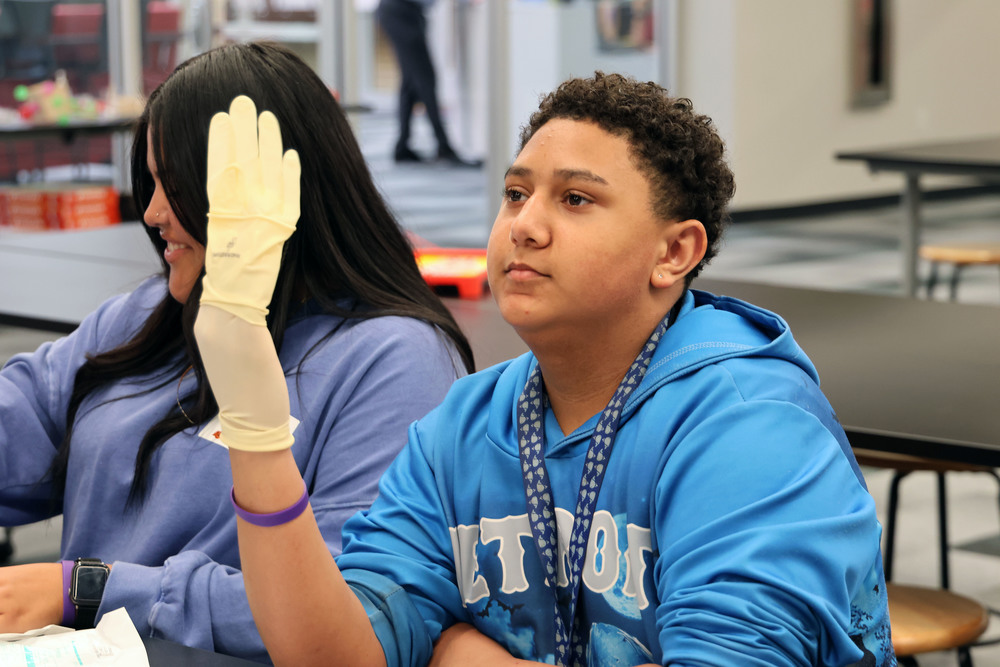
Lawton High freshman Nathaniel Reeves and Eisenhower High senior Mariyah Wiley say Operation Orange helped them solidify plans to pursue careers in medicine.
The two were among almost 30 Lawton Public Schools students who spent the morning at Operation Orange’s host site, the STEM center of the FISTA Innovation Park. Coordinated by the Oklahoma State University Center for Health Sciences, the program allows students to do a deeper dive into the world of science and medicine.
The idea is to give students a chance to explore the real world of medical skills and career pathways, said Raegan Teakell, FISTA’s STEM coordinator. The program featured 20-minute sessions in anatomy, heart health, veterinary medicine, CPR, casting and splinting, and surgery, taught by medical personnel or OSU graduate students. Each session included hands-on activities, ranging from learning how to put on surgical gloves, to performing CPR, to handling a human brain.
Dr. Mercedez Bernard, program director of Memorial Health System of Southwest Oklahoma’s family medicine residency, helped get the morning off the ground, telling students she participated in Operation Orange as a high school student before earning her medical degree at OSU. Bernard said OSU and sponsoring organizations like Memorial Health System had a specific goal in mind.
“We entice you a little bit,” she said, adding that in addition to convincing students to pursue careers in medicine, she hoped they would consider locating in underserved rural communities.
Many students participating in Operation Orange said medicine and science were their career goals.
Eisenhower High senior Mariyah Wiley and MacArthur High freshman Keylei McLinden were among that number, and both have specific careers in mind. McLinden is leaning toward pediatrics; Wiley said the morning had helped cement her plans to be a pediatric internist.
The two teens partnered in the CPR session, which ended with students working in pairs doing compressions on a mannequin torso. Teams competed against each other, working toward the highest number of compressions they could do in two minutes.
Wiley and McLinden coordinated their efforts perfectly, each pumping the mannequin’s chest 30 times before switching places without losing a beat. Their effort won them third place.
“You have to practice a lot. You have to keep up compressions,” Wiley said, explaining she and McLinden shared the work in this situation, but when there is only one person at an actual emergency, it would be more difficult.
McLinden agreed coordination was key, adding she has CPR experience.
“I’ve done it a lot, so I feel I didn’t do too bad,” she said, adding the hardest part was “getting the rhythm down” to seamlessly switch back and forth.
In the veterinary science area, Dr. Girish Patil, OSU assistant professor of veterinary medicine, introduced students to skulls, femurs and blood samples of fleas, ticks and worms. He pointed to a table lined with seven skulls and seven femurs, inviting students to identify them (cards at each bone told students if they guessed correctly).
Destyn Nieves, Eisenhower High freshman, was amazed at the identity of the largest skull on the table (a horse) and correctly guessed the identity of a much smaller skull (a dog).
“I expected it to be bigger,” Nieves said of the dog skull.
Eisenhower High senior Makayla Knight said she identified four of the seven skulls, admitting she missed the pig and horse because neither looked as she expected. Her observations drew Patil’s attention, as he explained the reason the pig’s skull was different colors was because each color highlighted a different bone. That made sense to Knight.
“Just like a human baby’s skull has three bones until they fuse?” she asked, getting an affirmative answer and tips about brains and skull size in animals.
Knight enjoyed the discussion, explaining she has definite career plans.
“I see myself as a phlebotomist,” she said, adding she could work her way up to that specialty after becoming an RN or ultrasound technician.
In the splinting session, most students worked in two-person teams, playing patient and doctor. Eisenhower High sophomore Olivia Baker worked by herself, wrapping her own wrist and hand. It wasn’t an ideal situation, but it’s a handy skill to have if you are by yourself, she said.
“If you’re in pain, it would be harder,” Baker said of her solo effort, adding she is familiar with arm injuries because she is a boxer.
While Baker did well, splinting won’t be necessary in her chosen profession.
“I do autopsies,” she said, explaining her medical field of interest is coroner; she has been interested in diseases since she was a child and her desire to be a coroner stems from a need to understand disease.
There’s another benefit.
“I don’t like blood,” she said.
Ava Towns and Skye Smith, Eisenhower sophomores, worked as a splinting team, Smith as the patient, Towns the attending physician. Both plan medical careers: Towns as a pediatrician; Smith in sports medicine.
“That’s not horrible,” Towns said, as she finished wrapping. “Girl, as long as your arm is secure,” she said, as Smith questioned the wrap.
Over in medical surgery, Memorial Health Services surgical RN Susan Milam explained how that area worked, noting some details have become common knowledge due to Covid.
“Covid taught you the highest level of filtration (masks) is N95,” she said.
After explaining why OR linens are blue (white would reflect the blinding light used in operating rooms), Milam moved the students into an exercise about donning surgical gloves while keeping them sterile.
It’s not easy. The gloves come in a sterile packet and you can’t touch anything but the inside of the upper cuff to put them on, Milam said as she demonstrated. She warned students that touching anything – even your face or any part of your body below your waist – contaminates the gloves, something several students quickly learned.
Lawton High freshman Nathaniel Reeves was among struggling students (the first glove was easy; the second one took more coordination). It’s a skill Reeves will need because he wants to become a neurologist.
“I’m interested in the brain,” he said, adding that was why his favorite session was anatomy, where he got to handle a real human brain, lungs and hearts.
He said it is amazing how important the brain is “for something so small,” adding the session helped explain the crucial link between the lungs and other organs. “They need oxygen, especially the brain.”
Angela Howard, sports science and health sciences teacher at the Life Ready Center, said those bits of information, along with hands-on experience, is exactly what LPS wanted for its students in Operation Orange.
“It gives them hands-on exposure,” she said, explaining hands-on learning is more beneficial than reading or staring at a computer screen. “The more repetitive, the easier it becomes.”