
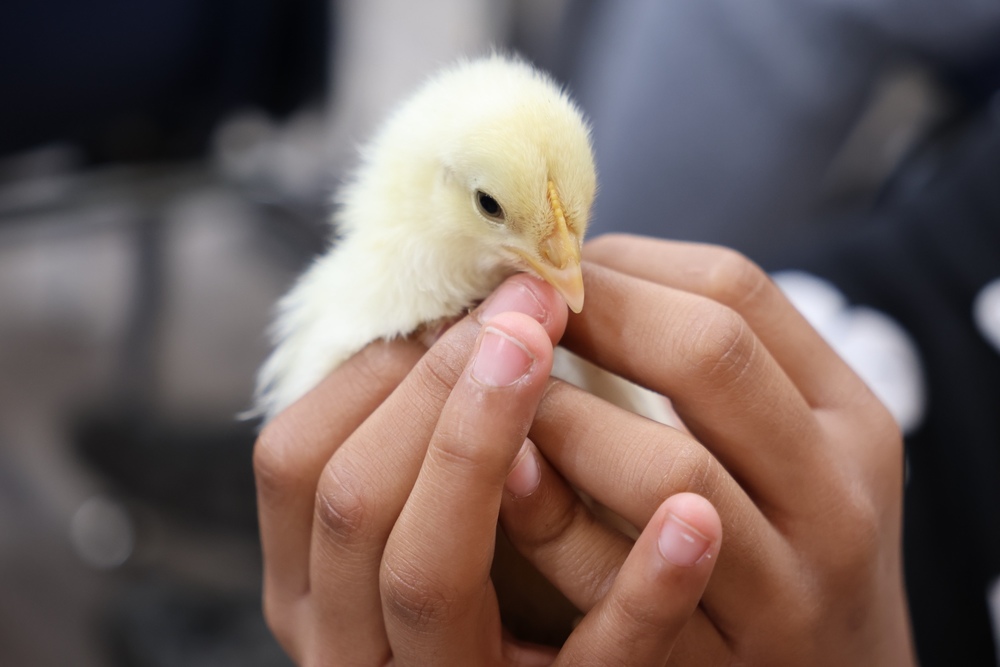
Christina Leija has something fowl in her classroom that is attracting a lot of visitors, including the principal, teachers and custodians.
Everyone, it seems, wants to drop in and ooh and ahh over the fowls that have taken up residence in a section of Leija’s Makerspace classroom at Eisenhower Elementary School. The fowl include 34 baby chicks and 8 ducklings so far; baby turkeys are expected the first week in March.
The project is funded by a Lawton Public School Foundation grant. When the grant applications became available, Leija asked Eisenhower Principal Charity Williams if she could apply for a grant to fund the chickens, a chicken coop, two incubators and all the other paraphernalia needed to care for the newborns.
“She loved the idea,” Leija said of Williams’ response.
And Williams has been a frequent visitor since the baby chicks and ducks arrived. In fact, she has “adopted” a solid black chick and named it Mahogany. One recent day she scooped Mahogany up and took Mahogany to her office for a few minutes.
“I just put her to sleep,” Williams said as she returned to the classroom and placed the chick back in the warm brooder with its fellow denizens, promising to return later.
Williams isn’t the only one enthralled with the new additions. A steady stream of school personnel come through several times a day to check on the little ones.
Then there are the students, who are the ones targeted to benefit from this fowl experiment. Leija, who lives on a farm with chickens, roosters, ducks, goats and assorted other farm animals, said she wanted to introduce students to agriculture.
“The sooner we get to introduce it, the better. We want to spark that interest at a younger age,” she said.
Leija had planned on only hatching some baby chickens, but the duck eggs were added after a predator killed one of her ducks after she had laid her eggs. Leija said her daughter was devastated, so Leija brought the duck eggs to school to hatch so the memory of the duck would live on. Then a friend helpfully added some turkey eggs.
The students have been captivated by all the fuzzy little critters who are joining them for their lessons. But the babies aren’t just for holding and cuddling, which Leija said students enjoy the most; they are a teaching tool. To that end, Leija has gotten fifth graders involved in their care. She chooses 2-3 students every day to help care for the little ones by giving them food and water, changing their bedding and cleaning out the brooders.
“They love it because they get to hold all the babies,” Leija said. “They learn how to take care of them. It teaches them responsibility and care.”
Briana Weisbrod, fifth grader, is one of those who has volunteered to help. She said she learned to care for baby chicks at her school in Illinois last year.
“It’s really fun and they are really cute,” she said.
Students who are too young to provide care are learning other lessons. A group of fourth graders used a microscope to take a closer look at the shells of the chickens and the ducks, where Benjamin Mentel, fourth grade, pointed out that the red streaks in the shells were the veins.
He said besides holding the newborns, he enjoys “when they chirp, and looking in their cage and they are all huddled together.”
Rylee Christensen, also in fourth grade, said she had noticed a difference between the chickens and the ducks. For one thing, the baby ducks are bigger than the baby chickens.
“Maybe because the duck flies. It needs to balance itself when it grows up,” Christensen said.
She also had a theory about duck feathers.
“They get bigger feathers and better feathers,” she said. “They need new ones because if they keep the old ones, the little feathers might rip so they need new ones to fly.”
Overall, she said she prefers chickens.
“I really like chickens, plus they taste good,” she said.
Leija said she plans to continue the program next year and would like to become a supplier of chickens for the middle school’s Farm-to-Table program.