
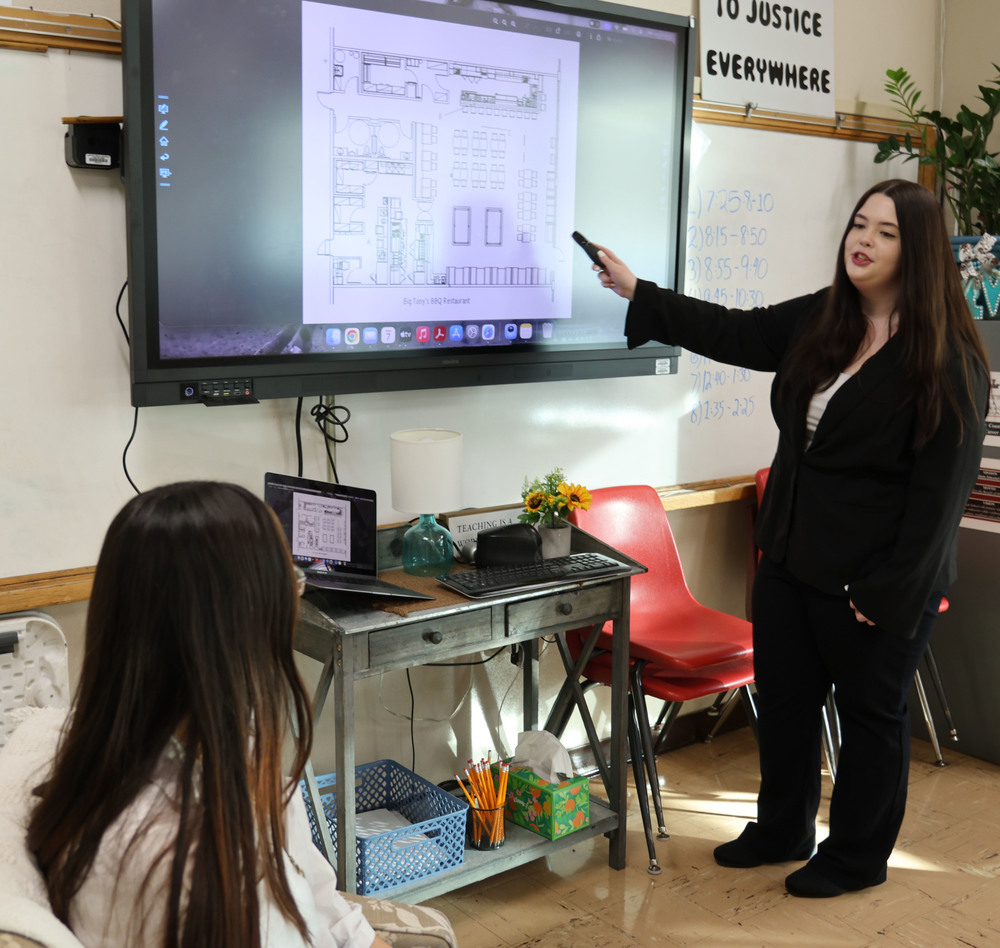
Members of Wolverines Under Oath can’t compete in this year’s High School Mock Trial Competition, but that doesn’t mean they haven’t learned the case and are practicing how they would handle the pressure of a courtroom.
The mock trial club is in its second year at Lawton High, and members had planned to enter the 2026 state competition, where 24 teams compete against each other to become the state winner who will represent Oklahoma in nationals. Funded by the 21st Century grant program, Wolverines Under Oath formed too late last year to enter the state competition.
This year’s problem is numbers: Teams must have at least six members to compete and the Wolverines have only four active members.
It’s not lack of interest; it’s balance, said Lawton High sponsor Misty Neal. Students who want to participate in the mock trial club must choose between other activities and Wolverines Under Oath, which takes a lot of time as students prepare for their mock trial competition.
So, Lawton High will be observers again, said sophomore Valerie Schrock, a driving force in creating the club last year. But, not just observers. Students have been practicing the roles in this year’s civil case. That’s important because while watching preliminary rounds in Tulsa on Jan. 19, it is possible members of the Lawton team might serve as fill-ins on teams practicing for the qualifying rounds that begin Jan. 26.
That’s why Schrock and classmate Mia Trickey had scripts in their hands the week after Winter Break, practicing their roles as attorney and witness in a case that was released to students Oct. 31.
The premise: “Little Tony” Shapiro claims an intruder burned down his restaurant in rural Smokehouse, Oklahoma, in a struggle during an attempted robbery and now Blackstone Insurance Group won’t pay his insurance claim. Blackstone says it rejected the claim because Shapiro burned down his own restaurant.
The “case” will be heard in Tulsa County District Court, and high school students will play the roles of attorneys and witnesses, arguing their case before a real district judge.
Neal said students have been reading and learning the case since it was released by the Oklahoma Bar Association (which oversees the mock trial program), working around fluctuating levels of participants who have had to adjust their schedules for other afterschool activities. Neal, who earned a law degree, knows just how much work students have to put into the project and understands why some students can’t participate fulltime.
While the club can’t compete, students still want to learn and will attend a practice session at the invitation of the coordinator, Tulsa District Judge Daman Cantrell.
“We’ll still watch it and let the kids see what they’re doing,” Neal said, explaining the competition is as realistic as possible.
While students fill key roles such as prosecutor, defense attorney and witnesses, they are arguing in a real courtroom before a real judge, with real attorneys acting as judges to rate each team as they look for a state winner.
Neal said the mock trial club was created at the insistence of students, so it’s important for them to keep their hands in the process.
Schrock said the Oklahoma Bar Association works to keep the process interesting. While last year’s case was criminal (the sibling of a teen who died after using a vaping pen laced with “illicit materials” faced murder charges), this year’s case is civil. Schrock said she appreciates the switch because it exposes students to both kinds of law.
There are definite differences, Schrock said, explaining last year’s case was a murder, meaning someone died. This year, there is a victim, but no death.
“It’s a different matter,” she said, explaining the case involves different sides – Shapiro on one, the insurance company on the other.
Schrock said she has a definite interest in the process.
“I have my mind set on becoming an attorney,” she said, adding that is why she pushed so hard to form the mock trial club.
That may be the reason she likes the fact the Bar Association changes things up, explaining this year’s case “offered rabbit holes to go into.”
“It’s cool,” she said, adding legal work “is a lot more complex than people realize.”
Neal said that might be the biggest issue with the mock trial club: students think they know about the law from watching it on television.
“Kids look cool,” she said, adding they don’t realize just what a commitment the activity is and how they need to apply themselves to make it work.
Schrock and Trickey said the process is decidedly hands-on, explaining there are reams of information to be processed as they prepare for court, to include understanding the legal background. Schrock said it took her a while to learn it all, noting “it’s really like a wizard’s manual” in terms of understanding.
That complexity is part of what Neal likes about the program.
“It teaches them to think, how to articulate their thoughts,” she said, explaining students learn how to think outside the box and to become problem solvers using logic, while also encouraging them to take the initiative and work together.
Students offered mixed reviews. While Schrock seems to be a lock for a legal career, Javion Henning and Beth Cooper said they aren’t certain and like the idea of playing various roles.
Even without career expectations, the club has produced results, Neal said, pointing to changes in self confidence for some. Cooper, a second-year student like Schrock, said she’s not as quiet as she used to be.
The 21st Century federal grant program supports community learning centers, an afterschool program designed to help high school students meet academic standards in core subjects such as math, reading, science and social studies. The goal is to help students become ready for college and careers.